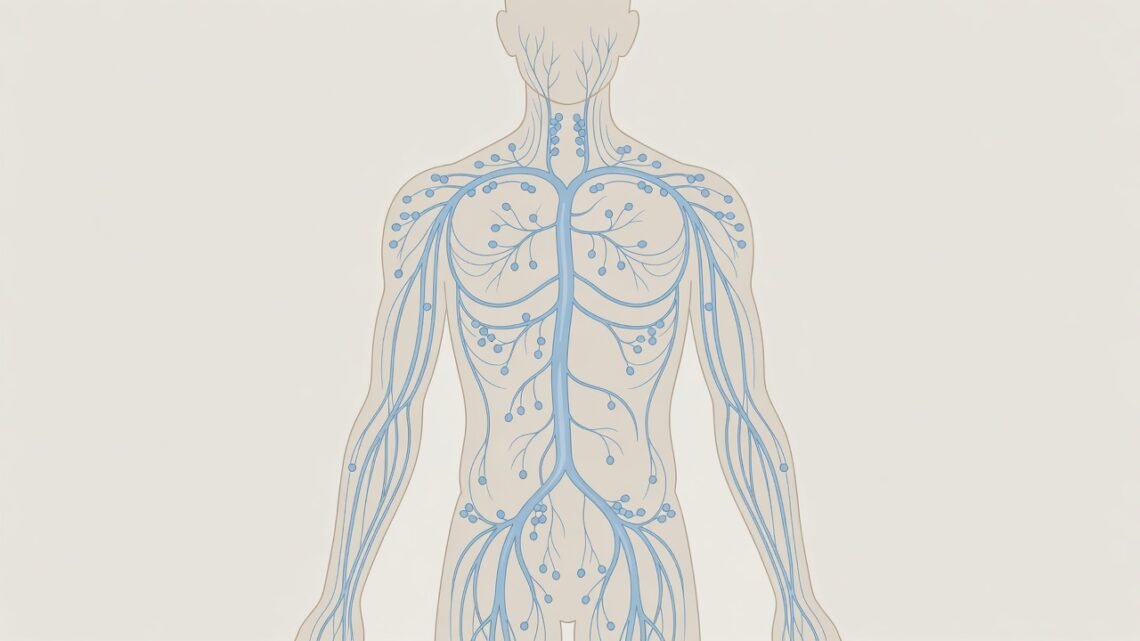
Short answer: The lymphatic system is a network of thin vessels, lymph nodes and organs such as the spleen, thymus and tonsils. It collects fluid that leaks out of your blood vessels into the tissues, filters it through lymph nodes, and returns it to the bloodstream. Along the way it carries immune cells that help the body deal with infection. It has no pump of its own: muscle movement, breathing and one-way valves keep lymph moving.
By the Articles Daily Editorial Team. Published 2 November 2026. Researched from the NHS, NICE, Cochrane, the British Lymphology Society, Cancer Research UK and the other sources listed at the end. This article has not been reviewed by a medical professional.
In this guide
- What the lymphatic system is
- How fluid balance works
- Lymph nodes and the immune system
- What actually moves lymph
- When the system struggles: lymphoedema
- Swelling that needs medical attention
- What this means for supplements
- Frequently asked questions
- Sources
What the lymphatic system is
Most people know the heart and blood vessels. The lymphatic system runs alongside them and does two linked jobs: it drains excess fluid from the tissues and it forms a major part of the immune system (MedlinePlus; NHS). It is made up of lymph vessels, lymph nodes, and organs including the spleen, thymus, tonsils and adenoids (Cancer Research UK).
The fluid inside it is called lymph. Cancer Research UK describes it as a straw-coloured fluid that carries proteins, waste products, bacteria, viruses and old or damaged cells away from the tissues. Lymph from the gut, called chyle, also carries fats absorbed during digestion (Cancer Research UK; Cleveland Clinic).
How fluid balance works
Blood is under pressure, so a little fluid constantly seeps out of the smallest blood vessels into the spaces around your cells. Most of it is reabsorbed, but not all. Cleveland Clinic gives a useful sense of scale: of roughly 20 litres of plasma that leaves the capillaries each day, about 17 litres returns directly and about 3 litres is collected by the lymphatic vessels (Cleveland Clinic).
That collected fluid travels through progressively larger vessels and lymph nodes until it reaches two main channels, the thoracic duct and the right lymphatic duct. These empty into large veins near the neck and upper chest, so the fluid rejoins the blood (Cancer Research UK). If that return route were blocked, fluid would gradually build up in the tissues, which is exactly what happens in lymphoedema.
Lymph nodes and the immune system
Lymph nodes are small, bean-shaped filters found in clusters in the neck, armpits, groin, chest, abdomen and pelvis. They hold white blood cells called lymphocytes. When B cells and T cells in a node meet bacteria or viruses, they multiply and respond, which is why nodes can swell when you have an infection (MedlinePlus; Cancer Research UK).
Infection is the most common reason for swollen nodes. Cancer is a much less common cause, but because abnormal cells can lodge in nearby nodes, a node that stays enlarged, feels hard or keeps growing should be checked by a GP (MedlinePlus).
What actually moves lymph
There is no heart-like pump for lymph. The NHS explains that surrounding muscles move the fluid, which is one reason exercise is part of lymphoedema care (NHS). US National Cancer Institute training material lists the main forces: contraction of skeletal muscles, the pressure changes of breathing, and smooth muscle in the walls of the larger lymph vessels. Valves inside those vessels stop lymph flowing backwards (NCI SEER).
In practical terms, that means movement matters. When you walk, the muscles in your legs squeeze the vessels between them, and the valves keep the fluid heading towards the chest. Long periods of sitting or lying still remove that squeeze. Our guide to everyday habits that support normal lymphatic function looks at what the evidence does and does not show about movement, breathing and hydration.
When the system struggles: lymphoedema
Lymphoedema is long-term swelling caused by a lymphatic system that cannot drain fluid properly. It can be present from birth or develop later, for example after cancer surgery or radiotherapy that removes or damages lymph nodes. It usually affects an arm or a leg, and the skin can become tight, hard and more prone to infection (NHS).
There is no cure, but the NHS describes a treatment approach called decongestive lymphatic therapy: compression garments or bandages, skin care, exercise and, in some cases, a specialist massage technique called manual lymphatic drainage (NHS). We look at how strong the evidence is for that massage in lymphatic drainage massage: what the evidence actually says.
Swelling that needs medical attention
Swelling has many causes, and some are serious. The NHS advises:
- See a GP urgently or call NHS 111 for swelling in one leg, ankle or foot with no known cause, sudden, severe or painful swelling, a red or hot swollen area, or feeling very hot, cold or shivery (NHS).
- Call 999 if swelling comes with shortness of breath, chest tightness or pain, coughing up blood, a racing heartbeat, or feeling faint or confused. This can be a sign of a blood clot in the lung (NHS).
- See a GP about persistent swelling of an arm or leg, and as soon as possible if the skin becomes red or hot, which can be cellulitis (NHS).
What this means for supplements
Because the lymphatic system is easy to describe in simple terms, it is a popular theme for supplement marketing, which often talks about lymph being “sluggish” or “clogged”. None of these words, nor “detox”, describes a diagnosis, and the NHS treats genuine lymphatic problems with the approaches above rather than with supplements. A 2022 review of supplements studied in lymphoedema concluded that none has been proven as a therapy (PubMed review, 2022).
If you are weighing up a product sold with lymphatic claims, our independent LymphFlow review sets out what one popular supplement contains and what the evidence shows, and our lymphatic health myths and facts guide lists the questions worth asking before you buy anything.
Frequently asked questions
What does the lymphatic system do?
It drains excess fluid from the tissues, filters it through lymph nodes and returns it to the blood. It also carries and houses immune cells that help fight infection (MedlinePlus).
Does the lymphatic system have a pump?
No. Lymph is moved by surrounding muscles, the pressure changes of breathing, smooth muscle in larger vessels and one-way valves (NCI SEER; NHS).
Why do lymph nodes swell?
Usually because the immune cells inside them are responding to an infection. A node that stays swollen, feels hard or keeps growing should be checked by a GP.
What is lymphoedema?
Long-term swelling, usually of an arm or leg, caused by the lymphatic system not draining fluid properly. It is managed with compression, skin care, exercise and sometimes specialist massage (NHS).
Can a supplement fix the lymphatic system?
No supplement has been proven to treat lymphatic conditions. A 2022 review found none proven as a therapy for lymphoedema (PubMed). Anyone with unexplained swelling should see a GP.
Sources
- NHS: Lymphoedema
- NHS: Lymphoedema treatment
- NHS: Swollen ankles, feet and legs (oedema)
- MedlinePlus: Lymph system
- Cleveland Clinic: Lymphatic system
- Cancer Research UK: The lymphatic system and cancer
- Cancer Research UK: Lymphoedema and cancer
- National Cancer Institute SEER training: Components of the lymphatic system
- Review of supplements studied in lymphoedema (2022)