
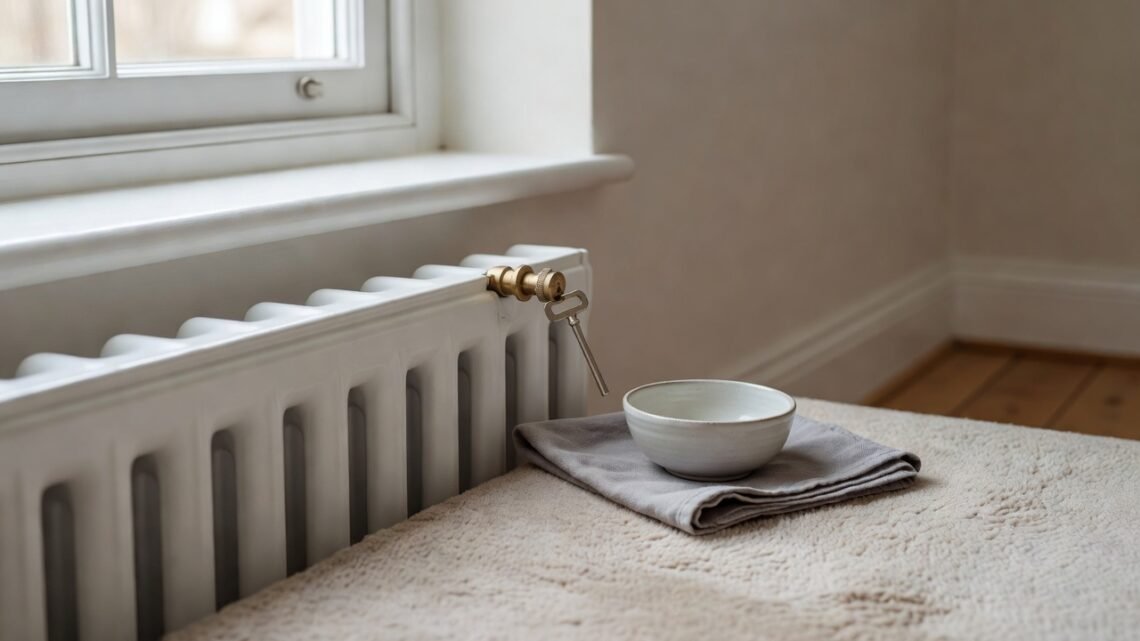
Short answer: This is how to bleed a radiator: turn the heating off, let the panel cool, and open the small valve on top until trapped air hisses out and water runs steadily, then close it. Cold patches across the top, gurgling, or a room that never quite catches up are the usual signs. On a combi or sealed system, check the boiler pressure afterwards and top up only to the cold level on the gauge or in the manual. Gas, the flue, and the inside of the boiler belong to a Gas Safe registered engineer.
In this guide
- What bleeding a radiator does
- Signs a radiator needs bleeding
- What you need
- Safety before you start
- How to bleed a radiator
- Which radiator to bleed first
- Check the boiler pressure
- How to repressurise a combi boiler
- Open vented systems
- What the water is telling you
- If air keeps coming back
- When to call a Gas Safe engineer
- If you rent
- FAQ
What bleeding a radiator does
Hot water, not air, is what carries heat through a radiator. The boiler warms the water, the pump circulates it, and the panel passes the heat into the room. Air that gets into the circuit rises and sits in the high points. That is why the top of a radiator goes cool while the lower part still feels warm, and why you may hear a gurgle as water squeezes past the bubble.
Bleeding is opening that high point so the air can leave, then shutting the valve as soon as water follows. It is ordinary house maintenance. It will not fix a seized pump, a valve that is turned off, a leak, or a radiator full of sludge.
The bleed itself is much the same in most UK homes. The follow-up is not. A combi, and most sealed system boilers, keep the heating water under pressure, shown on a gauge. Letting air and water out can drop that reading. An older open vented system uses a small feed and expansion tank, often in the loft, and has no pressure to set. Do not top up a combi and a loft tank as if they were the same job.
Signs a radiator needs bleeding
Bleed a radiator when the pattern matches trapped air. Use this as a check before you reach for the key.
| What you notice | What it usually means |
|---|---|
| Cold across the top, warmer lower down | Trapped air. Bleed that radiator. |
| Cold along the bottom, hot at the top | Sludge in the panel. Bleeding will not shift it. |
| The whole radiator stays cold | A closed valve, an air lock in the pipe, or a wider fault. |
| Gurgling or tapping | Air in the radiator or nearby pipework. |
| Every radiator is lukewarm | Unlikely to be one bleed valve. Check boiler pressure, then get help if it persists. |
A single cold radiator with both valves open is a fair candidate for a bleed. A boiler that locks out, a pool under a pipe, or no hot water at all is not. Bleeding every panel “just in case” can drop the pressure on a sealed system and leave a second problem behind.
What you need
- A radiator key, the small square key sold for bleed valves. Look at the valve first: some newer ones take a flat screwdriver instead.
- A dry cloth or old towel.
- A small bowl or jug.
- Paper towel. The water stains emulsion and carpets.
You do not need to drain the heating, take the radiator off the wall, or touch the mains stopcock. Protect the floor and keep children away from the bowl. The water is often grey or black, and it can still be hot if you did not wait.
Safety before you start
Turn the heating off at the programmer or room thermostat and wait until the panels are cool. That is the most useful precaution. A system that has just switched off still holds very hot water.
Open the valve a fraction only. Inside it is a short metal pin. Unscrew it all the way and the pin can drop out, followed by a jet of dirty water. If that happens and the pin is still in your hand, screw it straight back in. If the pin is lost or the thread is damaged, catch the water, protect the floor, and call a heating engineer.
Stop at the radiator. Do not take the boiler case off, turn screws on the gas valve, or disturb the flue. Work on gas appliances is for an engineer listed on the Gas Safe Register. If you smell gas, do not touch light switches. Leave the property and call the National Gas Emergency Service on 0800 111 999 in England, Scotland and Wales, or 0800 002 001 in Northern Ireland. Do the same if a carbon monoxide alarm sounds. If anyone is seriously unwell, call 999.
How to bleed a radiator
Set aside about half an hour. If more than one radiator is affected, do them in one visit, then deal with the boiler pressure once at the end.
- Confirm the heating is off and the radiator you are about to open is cool to the touch.
- Set the numbered thermostatic valve to its highest number so water can move through the panel. Leave the lockshield at the other end exactly where it is. Both valves stay open during a bleed. Closing them traps the panel and the air is not replaced properly.
- Find the bleed nipple, usually a small square at one top corner. Remove any plastic cap. On a column radiator or towel rail it may sit on the top rail or the end.
- Hold a cloth and a bowl under the valve.
- Fit the key squarely. Turn it anti-clockwise about a quarter of a turn. You want a controlled hiss, not a spray.
- When the hiss becomes a steady trickle of water, turn the key clockwise and close the valve. Stop when the drip stops. Do not lean on the key. Overtightening damages the thread.
- Dry the area and watch it for a minute. A fresh drip needs a small further turn clockwise. If it will not seal, stop.
- Move to the next radiator. When you finish, put the thermostatic valves back to their usual settings and run the heating. After about half an hour the heat should spread over the whole panel, not just the bottom.
If nothing comes out, or the nipple will not turn under firm hand pressure, stop. Forcing it with pliers usually rounds the square off, and the valve then has to be replaced.
Which radiator to bleed first
Air rises, so upstairs radiators and wet towel rails collect it first. If only one top is cold, bleed that radiator. If several are affected, start on the highest floor. On each floor, start with the radiator furthest from the boiler and work back towards it. After the system has been drained and refilled, bleed every radiator in that same order, because refill water often brings air with it.
A towel rail on the heating circuit is bled like a radiator, from its top valve. An electric-only rail is not on the water circuit. Do not open it. A dual-fuel rail that is also plumbed into the heating can hold air: use the bleed point on the water side, with the electric element switched off and the rail cool.
Check the boiler pressure
On a combi or sealed system, bleeding releases water as well as air, so the gauge often falls. Read it when the system is cold. A hot system reads higher, and that rise on its own is normal. Topping up while the system is still hot can leave the pressure too high once it cools.
Many UK combi and system boilers are filled to somewhere around 1 to 1.5 bar when cold. Treat that as a common range, not a rule for your boiler. The green band on the gauge, or the figure in the manual, is the number to use. Digital displays sometimes only show pressure in standby or in a menu: the manual explains which screen to trust.
If the cold reading is already in range, do not add water before you bleed. Bleed, then look again. If the needle sits in the red, or water is dripping from the pressure relief pipe outside, do not top up. The boiler needs an engineer.
How to repressurise a combi boiler
Only do this on a combi or other sealed system, and only when the cold pressure is below the fill level in the manual. You are letting mains water into the heating circuit through the filling loop. You are not repairing the boiler.
- Heating off and boiler cool, so the gauge is a true cold reading. Note the number before you touch anything.
- Find the filling loop under or beside the boiler. It is either a short braided hose with a valve at each end, or a built-in lever or slot. If the hose is separate and not fitted, attach it only in the way the manual shows, with both valves closed first. Do not open random pipes.
- Open the valves slowly. On a hose loop, open one side, then use the other to meter the water in. Watch the gauge the whole time. Do not leave the room while water is entering.
- As soon as the needle reaches the cold fill level, close both valves fully.
- If the manual says an external hose should come off after use, remove it and put the caps back. A loop left open, or a hose left on with a valve seeping, can let mains pressure creep into the heating overnight.
- Look under the boiler for drips. If radiators gurgle again, bleed those panels, then read the gauge once more.
Stop if the pressure does not move, shoots up, or falls again as soon as the valves are shut. Filling over and over is not maintenance. Each top-up adds oxygen and dilutes the corrosion inhibitor already in the system. A drop that returns within a day or two usually means water is leaving somewhere.
Open vented systems
No pressure gauge on the boiler often means an open vented system. A small loft tank with a float valve replaces water as you bleed. You do not repressurise it, and there is no filling loop to open under the boiler.
Do not pour water into loft tanks or bend a float arm unless you are certain which tank feeds the heating. In many older homes the small feed and expansion tank sits near a larger cold water storage tank, and they do different jobs. An empty heating tank, an overflowing one, or any doubt about which is which is a job for a heating engineer. While you are up there, do not stand on the tank lid or the edge of the loft hatch.
What the water is telling you
Clear or lightly grey water, then a clean shut-off, is a normal result. Dark grey or black water is sludge: fine iron oxide from inside the radiators and pipework. A little colour is common in older systems. A radiator that keeps running black, or stays cold along the bottom, needs a heating engineer, not another bleed. Do not tip cleaners or inhibitor in through the bleed valve. Inhibitor belongs in the system at the correct dose, which is a job done when the system is filled or serviced, not poured into one panel.
Rusty red water can mean oxygen is getting in, sometimes past a leak or because the system is being topped up again and again. Mention the colour when you call, and do not keep adding fresh water to “see if it clears”.
If air keeps coming back
Needing a bleed after the summer shutdown, or once more during a long winter, is ordinary. Making it a regular chore through the heating season is not. The valve is only letting out air that something else is introducing.
Repeating air often comes from a slow leak, a failing automatic air vent on the pipework, a pump that is pulling air in, recent draining, or fresh mains water added too often. If sealed-system pressure is back near zero within a day or two, stop topping up. Look for green crust on valves, damp under pipes or on ceilings below pipe runs, and a boiler that warns of low pressure as soon as the heating runs. Then book an engineer. A magnetic filter and a fresh dose of inhibitor are common parts of that repair. They are not something to improvise from the bleed point.
When to call a Gas Safe engineer
Phone a Gas Safe registered engineer rather than going further yourself if:
- You smell gas, or a carbon monoxide alarm has sounded.
- The boiler leaks, locks out, or shows a fault you cannot clear by restoring normal cold pressure.
- The outside pressure relief pipe is dripping.
- Pressure will not stay up after the filling loop valves are fully closed.
- There is still no heat or hot water after a careful bleed.
- You see scorching, melted parts, or a flue that looks loose or damaged.
Find and check the engineer on the Gas Safe Register, and look at the ID card at the door. The card shows which categories of gas work that person is qualified to do. A stuck bleed screw or a weeping radiator valve is heating or plumbing work. It is not a reason to open the boiler case.
If you rent
Read the tenancy before you start. Bleeding a radiator is often treated as routine care, but agreements differ, and some landlords would rather their own contractor did it. Boiler faults, gas appliances, and leaks into ceilings should be reported to the landlord or agent, in writing, rather than tackled on the day. If you cannot tell whether the boiler is a combi, do not experiment with valves underneath it. Ask which boiler is fitted, and ask for the manual if there is one.
FAQ
Should the heating be on when I bleed a radiator?
No. A cool radiator is safer and easier to judge. Water from a hot system can scald, and a running pump makes it harder to hear when the air has gone. Switch the heating off and wait until the panel is cool to the touch.
How often do radiators need bleeding?
There is no fixed date. Bleed when a top goes cold, when you hear gurgling, or after the system has been refilled. If it turns into a regular job through the winter, something is letting air in. Look for a pressure drop or a leak instead of bleeding on a schedule.
Why is the bottom of the radiator cold?
That pattern is sludge, not air. Air sits at the top, which is the only part a bleed valve can release. Cold along the bottom means the lower channels are restricted. An engineer can advise whether a system clean, a magnetic filter, or a replacement radiator is the sensible next step.
What should combi boiler pressure read after bleeding?
Read the gauge when the system is cold. A lot of combi and system boilers then sit around 1 to 1.5 bar, but use the green zone or the figure in your manual if it differs. The reading climbs once the heating is hot. That climb, on its own, is expected. A drip from the outside relief pipe is not.
What if the bleed screw will not turn?
Leave it. A rounded nipple or a snapped pin turns a short job into a leak. A heating engineer can replace the valve. If water is already escaping and you know both radiator valves, turn the thermostatic head to zero or off, and turn the lockshield clockwise until it stops, to isolate that panel. If you are not sure which valve is which, use a bowl and towels and wait.
Will bleeding a radiator lower my heating bill?
No figure applies to every house, so none is quoted here. Radiators that heat evenly let a room thermostat reach its setting and switch the boiler off. Cold spots tempt people to turn the thermostat up, so the boiler runs longer. Bleeding restores even heat. It does not, on its own, repair an old or faulty boiler.
Sources
Gas Safe Register: the official UK register of engineers qualified to work legally on gas. Use it to find an engineer and to check that the work you need is covered by their listed categories. Boiler faults, gas leaks and anything inside the boiler case are for a registered engineer, not a DIY bleed.


