Affiliate disclosure: This article contains affiliate links. We may earn a commission if you purchase through them, at no extra cost to you.
Why pine boards cup after you bring them indoors
Pine boards cup after you bring them indoors because the wood is still adjusting to a drier environment. Boards sold or stored in sheds, garages and builders’ yards have a moisture content that matches those damp, unheated spaces. Once they sit in a heated room, the faces and edges dry at different rates, the outer fibres shrink more than the inner ones, and the board pulls itself into a curved, dish-shaped cross section known as cupping.
The good news is that cupping is predictable and largely preventable. Understanding how pine responds to moisture, and giving it time to reach equilibrium with your home before you machine or fix it, will solve most problems before they start.
Key takeaways
- Cupping happens when one face of a board loses or gains moisture faster than the other, causing uneven shrinkage across the thickness.
- Heated UK homes in winter are far drier than sheds and garages, so freshly moved timber has a big moisture gap to close.
- Stack and sticker raise boards flat with air flow around every face, and let them acclimatise for a week or more indoors before working them.
- Sealing all six faces of a finished board slows moisture movement and reduces the chance of cup returning.
- Wide, flat-sawn pine boards cup more readily than narrow, quarter-sawn ones, so choose your stock with the final location in mind.
What cupping actually is
Cupping is a warp pattern where a board curves across its width, so the surface looks like a shallow trough. It is different from bowing (a curve along the length) or twisting (the corners no longer sit in the same plane). Cupping happens across the grain, which is why the width of a board matters far more than its length.
Wood is hygroscopic, meaning it absorbs and releases moisture from the surrounding air. When one face of a board is wetter or drier than the other, that face expands or shrinks more, and the board bends toward the drier side. Convex side up if the underside is wetter, concave side up if the top is drying faster.
Why the indoor environment catches boards out
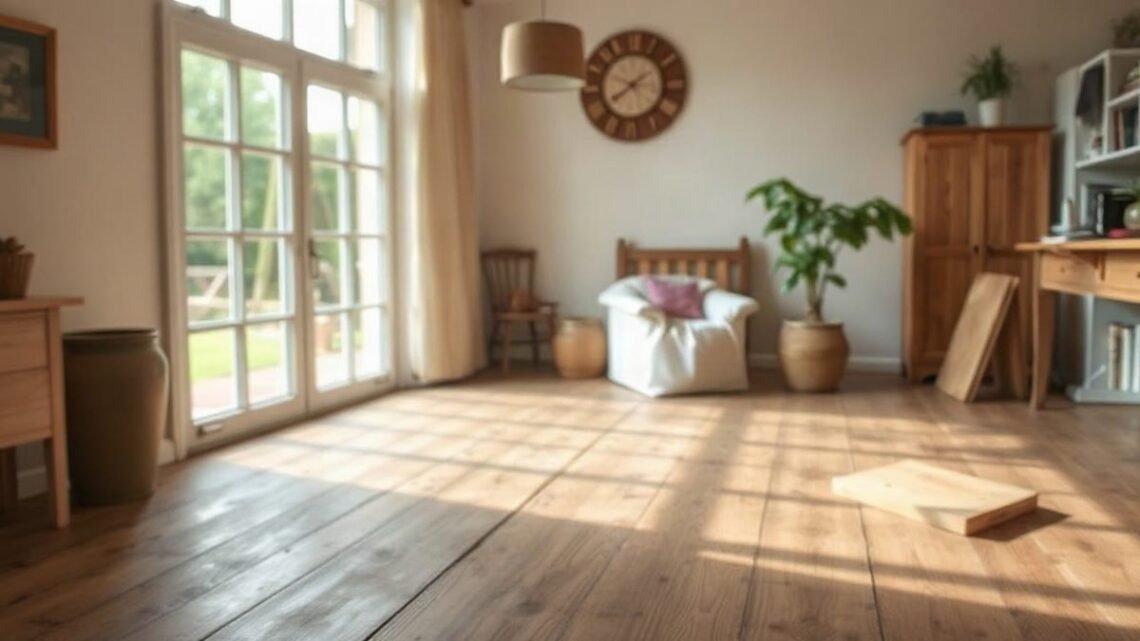
Timber in a shed, garage or timber merchant’s yard typically sits at a moisture content that matches the outdoor climate: damp and relatively stable. The air inside a heated British home, especially in winter with the radiators on, is much drier than that. Pine brought straight from the shed to the living room faces a sudden, one-way drying push.
As the board dries, the exposed faces lose moisture first. The centre of the board lags behind. If drying is uneven across the width or through the thickness, the differential shrinkage bends the board into a cup. The wider the board and the bigger the moisture gap, the more dramatic the movement.
Seasonal swings matter too
Even fully acclimatised boards keep moving with the seasons. Central heating in January pulls indoor humidity down, and a damp August pushes it back up. Pine that sits proudly flat in summer can develop a slight cup over a dry winter, then relax again in spring. This is normal wood behaviour, not a defect in the board itself.
Why pine is particularly prone
Pine is a softwood with a straightforward, fast-grown grain structure, and it is often sold flat sawn (plain sawn). Flat-sawn boards contain long, wide growth-ring arcs running across the face, and these rings shrink at different rates along their length than across their width. The result is a natural tendency for the face to curl away from the pith side.
Three features make pine a common offender:
- Wide growth rings. Fast-grown plantation pine has pronounced earlywood and latewood bands, which respond strongly to moisture changes.
- Usually flat sawn. Most affordable pine is flat sawn rather than quarter sawn, and flat-sawn boards cup more readily than quarter-sawn ones.
- Often wide and thin. Shelving and furniture pine is frequently sold in wide, thin sections, exactly the proportions that cup most easily.
How to prevent pine boards from cupping indoors
Prevention comes down to controlling how moisture leaves the board, and to letting the wood settle before you commit to it.
1. Acclimatise before you build
Bring pine into the room where it will live and stack it flat with thin sticks (stickers) between each layer so air can circulate around every face. Leave it for at least a week, and longer for thick stock, before planing, jointing or fixing it. The goal is for the board’s moisture content to reach equilibrium with the room, so that any movement happens while the board is still free to move.
2. Stack it flat and evenly supported
While the wood adjusts, store it flat on level supports with weights on top. A board that dries while resting on two uneven battens will often take on a permanent memory of that position. Stickers should be lined up vertically, one above the other, so nothing bends while it dries.
3. Seal all six faces
Finishing only the visible top face is a classic mistake. If moisture can enter and leave through the underside and edges, the board will always be unbalanced. Apply paint, oil, varnish or lacquer to the underside, edges and end grain as well as the face. End grain drinks moisture faster than face grain, so give it an extra coat.
4. Prefer narrower boards or quarter-sawn stock
Where the design allows, use narrower boards glued edge to edge rather than one wide panel. Individual narrow boards move less across their width, and the assembly as a whole stays flatter. If your supplier offers quarter-sawn or rift-sawn pine, it is inherently more stable across the width than flat-sawn stock.
5. Let the structure breathe
For fixed elements such as tabletops screwed to frames, use fixings that allow movement: slotted holes, figure-eight fasteners or buttons in a groove. Rigidly screwing a wide pine panel flat at every corner fights the wood’s natural movement, and the panel will usually win, either by cupping or by splitting.
Can you fix a cupped pine board?
Sometimes, yes. The right fix depends on how severe the cup is and how dry the board already is.
Shallow cup: flatten with moisture and weight
For a gentle cup, dampen the concave (hollow) face lightly, lay the board cup-down on a flat surface, and weight it evenly. As the hollow face picks up moisture and expands, the cup reduces. This is slow, and the board must then be resealed on all faces or the cup can return.
Moderate cup: plane or sand it flat
A cupped board run through a thicknesser or planed flat by hand works, but you lose thickness, and the moisture content must already be stable indoors or it will simply cup again. Sanding out a cup is only practical for very shallow distortion, because you will remove a lot of material across the width.
Sawn flat and re-jointed
For badly cupped wide boards, a common rescue is to rip the board into narrower strips, plane each strip flat, and re-glue them as a panel with the grain alternated. This is more work, but it produces a stable panel from otherwise unusable stock.
When to leave it alone
If a board is fixed in place, lightly cupped and structurally sound, forcing it flat with screws can split it. A small seasonal cup that comes and goes is often best tolerated, especially on rustic or painted work.
How long should pine acclimatise indoors?
There is no single answer, because the time depends on the thickness of the board, the temperature and humidity difference, and air circulation. As a practical rule for UK homes: give thin boards (under 25mm) at least a week, and allow two to three weeks or more for thicker stock, with stickers between layers and good airflow. Thicker boards dry and adjust much more slowly than their dimensions suggest.
A moisture meter takes the guesswork out. Indoor equilibrium moisture content in a heated UK home typically sits in a much lower range than shed-stored timber, and you are aiming for the board to stop changing before you work it. If you do not own a meter, the weight-and-wait approach with stickers is still far better than working timber straight from the car boot.
Common mistakes that make cupping worse
- Working timber straight from the shed. The most common cause of a project going wrong weeks later. Let it settle first.
- Finishing one face only. An unbalanced finish guarantees uneven moisture movement.
- Storing boards on edge against a wall. One face dries faster than the other, and the board bows or cups before you even start.
- Ignooring end grain. Board ends are the fastest route for moisture in and out; leave them sealed.
- Rigidly fixing wide panels. Build in room for seasonal movement with slotted or elongated fixings.
If you are planning a larger build, such as a garden workshop or storage shed where your timber will be stored, it pays to think about moisture and airflow at the design stage. A set of complete shed plans with sensible ventilation and build guidance, such as My Shed Plans (this is an affiliate link, which means we may earn a commission if you buy through it, at no extra cost to you), can be a useful reference for the design side. As always, judge any product on the seller’s own description and whether it suits your experience level; it is a set of plans and instructions, not a substitute for learning good timber-handling practice.
Affiliate recommendation
Mentioned in this article: My Shed Plans
My Shed Plans is a collection of plans for building garden sheds.
Read the seller’s information →
Affiliate link: we may earn a commission if you purchase, at no extra cost to you. We have not tested this product.
FAQ
Does cupping mean the pine is bad quality?
Not usually. Cupping is a normal response to uneven moisture change, especially in wide, flat-sawn boards. Well-handled pine that is acclimatised and sealed on all faces will stay flat in most homes. Poor stacking and one-sided finishing cause more cupping than bad timber does.
Which way should the cup face when I glue boards together?
A common workshop practice is to alternate the growth rings or the heart side of adjacent boards, so the natural cupping tendencies of each board oppose one another. Whatever arrangement you choose, clamp the panel flat and let the glue joint do its work on acclimatised timber.
Will painting or oiling stop pine from cupping?
Sealing slows moisture movement and greatly reduces cupping, but no finish stops it entirely. The important point is coverage on all six faces, including edges and end grain. A board sealed only on top will still cup because the underside keeps moving.
How flat should I expect a pine shelf to stay?
A narrow, well-sealed pine shelf in a stable indoor environment should stay essentially flat. Wide, thin, unsupported pine shelving will usually show some seasonal movement, particularly over a dry winter with central heating. Adding a batten or cleat underneath helps a shelf resist cupping.
Is quarter-sawn pine worth the extra cost?
For wide panels and tabletops, quarter-sawn or rift-sawn stock is more stable across the width and less prone to cupping, so many woodworkers consider it worth the premium for those applications. For narrow framing and painted work, standard flat-sawn pine is usually perfectly adequate once acclimatised.
Conclusion
Pine boards cup indoors for one simple reason: wood moves as it equalises with the moisture in the air, and heated rooms are much drier than the sheds timber comes from. Let boards acclimatise flat with airflow on all faces, seal every surface including the end grain, choose board widths with movement in mind, and allow fixings some room to breathe. Do that, and cupping goes from a recurring frustration to a rare and minor issue.
For your next project, start by stacking your timber in the finished room a couple of weeks ahead of time. Your joints, and your patience, will thank you for it.